Dangers of Catching Fish With a Net
Introduction
Catching fish with a net is one of the oldest methods of harvesting seafood, yet it comes with complex ecological, ethical and human safety issues.
As aquarium enthusiasts and responsible anglers here at tankmatez.com, we care about the aquatic animals we keep and the health of the ecosystems they come from.
Fishing nets are efficient tools, but their indiscriminate nature poses risks to non‑target species, habitats and even people.
In this article we ask critical questions about the dangers of catching fish with a net, explore science‑based evidence on environmental impacts, and share safer alternatives and responsible practices.
Before catching fish with a net, it’s important to understand the hidden dangers involved.
Everything You Need to Know About Net Fishing Risks ▼
What Is Bycatch and Why Does Catching Fish With a Net Cause It?

Whenever nets are placed into the water, they catch more than the intended species. The incidental capture of non‑target animals is called bycatch.
Conservation organizations warn that millions of marine animals are hauled up in nets each day and then discarded dead or dying.
Even fisheries regulators concede that bycatch is a major problem because modern fishing gear is highly efficient but largely unselective.
How does bycatch harm animals? When marine animals are hauled rapidly from depth by nets, the sudden change in pressure can rupture internal organs.
Animals trapped at the surface can suffocate for lack of oxygen or be crushed under the weight of the catch.
Those that survive entanglement may be tossed back into the sea severely injured, dramatically lowering their chances of survival.
Which species are most affected? Bycatch kills or injures an astonishing range of animals:
- Cetaceans (whales, dolphins and porpoises): Over 300,000 small whales, dolphins and porpoises die annually from entanglement in fishing nets. In the Indian Ocean alone, an estimated four million dolphins were caught as bycatch over recent decades, leading to an 80% decline in some populations. North Atlantic right whales are so threatened by net entanglement that a single female dying may imperil the species’ future.
- Sea turtles: All sea turtle species found in U.S. waters are endangered and bycatch is the single greatest threat to their survival. Turtles drown in trawl nets, get hooked on longlines or entangle in gillnets. This makes catching fish with a net especially dangerous for vulnerable sea turtle populations.
- Seabirds: Large birds such as albatross are drawn to baited hooks and longlines; they are pulled underwater and drown. In South Africa, using bird‑scaring streamers cut albatross bycatch by 90%.
- Sharks, rays and other apex predators: Pelagic shark populations have declined by more than 70% as a result of global fishing operations, and some sharks have fins removed before being thrown back. Predators keep ecosystems balanced, so their removal can trigger trophic cascades.
- Juvenile fish: Nets do not discriminate by size. Gillnets that allow fish to slip their heads through but trap their gills are notorious for catching juveniles, contributing to stock depletion.
Which Net Fishing Methods Cause the Most Harm?
Different net types have specific ecological footprints:
- Gillnets: Often several miles long and up to 100 feet deep, gillnets act like nearly invisible walls. Fish push their heads through the mesh and are snagged when trying to back out, while cetaceans and other large animals fail to detect them and become entangled. Lost gillnets continue to catch animals for years as ghost gear. This is one of the most harmful forms of catching fish with a net, since gillnets ensnare wildlife indiscriminately.
- Trawling nets: Boats drag enormous weighted nets along the sea floor or through midwater. Bottom trawling is particularly destructive; it damages or flattens coral reefs and sponge beds and destroys habitat complexity. Nets catch everything in their path: fish, sponges, turtles, corals, resulting in bycatch levels of up to 92% in some European waters. The heavy doors and chains that keep nets open plough the seabed, disturbing sediments and releasing up to 370 million metric tons of carbon dioxide annually—comparable to the entire aviation industry.
- Purse seine nets: Designed to encircle large schools of fish, purse seines are often used with fish‑aggregating devices that attract multiple species. Non‑target species such as dolphins and whale sharks are inadvertently captured.
- Longlines with nets or hooked lines: Longlines used for tuna or swordfish have thousands of hooks that attract turtles and seabirds. The hooks can cause suffocation or internal injuries when swallowed.
What are the Broader Ecological Consequences?
1. Collapse of fish populations and trophic cascades
Overfishing by nets can drive target species to near extinction.
Atlantic cod stocks collapsed in the 1990s after decades of intense trawling; some Canadian stocks declined by over 99%.
When predators are removed, prey species such as shrimp and snow crab proliferate, radically altering food webs. This kind of trophic cascade has occurred in many ecosystems, including with sharks and rays.
2. Habitat destruction and carbon release
Bottom trawling ravages seabed habitats. Coral reefs and sponge fields that took centuries to grow can be razed in a single pass.
The seafloor can be transformed into a flat, lifeless wasteland, reducing biodiversity and damaging nursery grounds for fish and invertebrates.
Disturbed sediments release stored carbon; around 55‑60% enters the atmosphere, contributing to climate warming, while the rest remains in the ocean and exacerbates acidification.
3. Ghost gear – Nets that keep killing
Lost or abandoned nets (ghost gear) continue to trap marine life indiscriminately.
NOAA’s Marine Debris Program notes that derelict gear can catch fish, crustaceans, birds, and other animals, posing a particular danger to endangered species.
Ghost gear can accumulate into large masses as nets, buoys and lines tangle together, and the most common ghost fishing gear types are gillnets and pots.
In the Chesapeake Bay, derelict crab pots kill about 3.3 million blue crabs and more than 40 species of fish; removing the pots could boost the blue crab harvest by 38 million pounds.
An abandoned gillnet on a Hawaiian reef captured parrotfish, goatfish, crabs and lobsters that decayed before anyone retrieved the net.
4. Ocean plastics and entanglement
Ghost nets contribute significantly to marine plastic pollution.
A review found that more than 350 species have been documented entangled in marine debris; all seven species of sea turtles, nearly one‑third of seabird species and almost 40% of marine mammals have been entangled.
Plastic bands, bags and discarded nets cut into animals’ bodies, impair swimming and feeding, and often cause death.
5. Human safety hazards
Nets are not only dangerous for wildlife—fishermen face serious hazards when working with heavy gear.
According to the U.S. National Institute for Occupational Safety and Health (NIOSH), between 2000 and 2019 there were 122 fatal injuries on fishing vessels, and 40% were due to contact with gear and equipment.
High‑tension lines and cables used to haul nets can cause amputations or fatalities.
Fishermen working long hours pulling nets suffer sprains, strains, lacerations and fractures.
Winches and deck machinery used with nets require emergency‑stop devices and guards to prevent entanglement.
6. Legal and ethical considerations
Laws attempt to curb the impacts of net fishing.
The U.S. Marine Mammal Protection Act and other federal laws require nations exporting fish to the U.S. to meet comparable bycatch reduction standards.
International agreements such as the UN Fish Stocks Agreement urge the precautionary approach and ecosystem considerations. Despite this, illegal, unreported and unregulated fishing and weak enforcement still allow destructive net practices to persist.
Ethics also matter: causing unnecessary suffering to sentient marine animals or endangering populations for profit raises serious moral questions.
Can Gear Modifications Reduce the Dangers?
There are promising solutions and technologies that can reduce bycatch and habitat damage without eliminating net fishing entirely.
Many of these improvements come from fishers themselves:
- Turtle Excluder Devices (TEDs): These grates attached inside trawl nets provide an opening that allows turtles and other large animals to escape. After TEDs became mandatory in some fisheries, turtle bycatch declined by up to 99%. The recovery of Kemp’s ridley turtles in the Gulf of Mexico is partly credited to TEDs.
- Circle hooks and hook modifications: Replacing J‑shaped hooks with circle hooks reduces sea turtle deaths by preventing deep swallowing; this innovation decreased turtle mortality by as much as 90% in some longline fisheries. Different light frequencies on longlines can attract fish without attracting turtles.
- Pingers and bird‑scaring devices: Acoustic pingers on nets deter marine mammals such as porpoises and dolphins, while brightly colored streamers hung above longlines deter seabirds.
- Selective fishing methods: Pole‑and‑line fishing targets individual fish with nearly zero bycatch. Diver harvesting of oysters and other shellfish is more selective and causes less habitat damage than dredging.
- Escape panels and dissolvable ghost panels: Crab pots fitted with escape rings prevent terrapins and undersized crabs from entering. Dissolvable panels release trapped lobsters if the trap is lost for more than a few months.
Is it Ever Safe to Catch Fish with a Net?
In certain contexts, using a net is a practical and accepted way to catch fish.
Aquarium keepers often use small hand nets to move fish between tanks or to remove sick individuals.
When done carefully under supervision, these nets pose minimal risk to the fish. However, large‑scale or unsupervised net fishing carries significant dangers. Here are guidelines for responsible net use:
- Know the laws: Ensure your fishing method is legal in your region. Many jurisdictions require special permits for gillnets or limit their use to particular species or seasons. Some areas ban nets entirely due to endangered species concerns.
- Use the right net: Smaller mesh nets trap smaller fish. Choose a net size that targets the species you intend to catch and allows juveniles to escape. Avoid deep nets that hang far into the water column, where they will catch unintended animals.
- Supervise continuously: Never leave a net unattended. Frequent checks allow you to free non‑target species quickly and avoid suffocation. If using a cast net or seine in shallow water, have a second person on hand to help release bycatch promptly.
- Avoid sensitive habitats: Do not drag nets across coral reefs, seagrass beds or rocky substrates. These areas are essential nursery grounds for many species and easily damaged.
- Prevent ghost gear: Secure nets properly and remove them after use. If you lose a net, report it to local authorities or marine conservation groups to assist with retrieval. Participate in ghost gear clean‑ups.
- Consider alternative methods: Where possible, use rods and lines, traps with escape panels, or selective gear like pole‑and‑line. These methods reduce bycatch and habitat damage and are often more humane.
- Support sustainable fisheries: Look for seafood certified by reputable organizations and ask fishmongers about gear types used. Choose species caught with low‑impact methods.
Even small-scale catching fish with a net requires caution to avoid harming fish.
What Can we do as Consumers and Hobbyists?

The choices we make matter. On tankmatez.com we encourage hobbyists to engage ethically with aquatic life.
Consider these actions:
- Educate yourself: Understanding the impacts of net fishing empowers you to make responsible choices. Share information with friends and family to raise awareness.
- Advocate for stronger regulations: Support policies that restrict destructive fishing practices, mandate bycatch reduction technologies and protect critical habitats. The U.S. State Department works with NOAA and other agencies to promote international measures that reduce bycatch of juvenile fish and vulnerable species.
- Reduce demand for unsustainable seafood: Consumer demand drives fishing methods. Choosing sustainably caught or farmed fish can shift industry practices. Avoid seafood that may come from destructive bottom trawl fisheries or illegal gillnet operations.
- Participate in clean‑ups: Join local efforts to remove ghost gear and marine debris. Every derelict net removed saves countless animals.
- Support innovation: Many fishers and scientists are working on alternative gear and practices. Funding research and competitions like the International Smart Gear Competition encourages new technologies that reduce bycatch.
One of the easiest ways to avoid the dangers of catching fish with a net is to switch to a low-stress capture method like the TankMatez Bubble Fish Trap. Unlike traditional nets which cause panic, fin damage, and unnecessary stress, our clear acrylic globe trap uses the fish’s natural feeding instincts to gently guide them inside without chasing or touching them. This creates a far safer, calmer experience for both the fish and the keeper. For hobbyists who want a humane, modern alternative, the TankMatez Bubble Fish Trap eliminates nearly all the risks associated with catching fish with a net.
Conclusion – The Importance of Responsible Fishing
Catching fish with a net has provided food and livelihoods for centuries, but today we understand the profound ecological and ethical costs associated with indiscriminate net use.
Bycatch kills thousands of marine mammals, sea turtles, seabirds and sharks each year and undermines ecosystem stability.
Bottom trawling destroys habitats and releases vast amounts of carbon, while ghost gear continues to kill long after it is lost. Human safety risks and legal issues further complicate net fishing.
For aquarium keepers, anglers and seafood consumers alike, being informed and making thoughtful choices can help reduce these dangers.
Opting for sustainable fishing methods, advocating for stricter regulations, adopting bycatch‑reducing technologies and supporting clean‑up initiatives are all steps we can take.
Net fishing is not inherently evil, but without careful regulation and responsible practices, it threatens the very marine life we cherish.
What are some sustainable fishing practices?
Sustainable practices include pole-and-line fishing, using escape panels, Turtle Excluder Devices, selective traps, and avoiding destructive gear like gillnets and bottom trawls.
How do fishing nets work?
Fishing nets trap fish by entangling them or enclosing them in mesh. Many nets are non-selective, catching unintended species and causing significant stress or injury.
Is net fishing legal?
Yes, but regulations vary by region. Some countries restrict or ban certain nets due to bycatch, habitat damage, or risks to endangered species.
Why is sustainable fishing important?
It protects marine ecosystems, prevents overfishing, reduces bycatch, and ensures fish populations can thrive long-term.
What is net fishing?
Net fishing is the practice of capturing fish using mesh nets such as gillnets, trawls, seine nets, or cast nets.
Is sustainable fishing possible?
Yes. When fishers use selective gear, follow science-based quotas, and avoid damaging habitats, fishing can be both productive and environmentally responsible.
Why does my fish freak out every time I try catching it with a net?
Nets trigger panic because they resemble predators and require chasing, which stresses fish and can cause injury.
How do I move a fish without stressing it out or damaging its fins?
Use a stationary, bait-based trap instead of a net. This avoids chasing and lets the fish swim in calmly on its own.
Is there a gentler way to catch fish than chasing them with a net?
Yes, using a passive trap like the TankMatez Bubble Fish Trap, which relies on natural feeding behavior instead of pursuit.
Why won’t my fish come out from hiding when I use a net anymore?
Fish learn quickly. After stressful net experiences, they associate nets with danger and instinctively hide.
How can I catch a sick fish without hurting or exhausting it?
Use a low-stress, hands-free trap that lets the fish enter gently, reducing the risk of additional stress or exhaustion.
How do you catch a super fast fish without turning the tank into chaos?
Avoid chasing altogether. Place a baited trap and let the fish enter on its own.
What’s the easiest way to catch fish that hide behind rocks or coral?
Use a small, clear trap that fits near rockwork like the TankMatez Bubble Fish Trap instead of trying to net through tight spaces.
Why is netting fish in my reef tank so hard?
Reef tanks are full of fragile rock and coral, making nets difficult to maneuver without causing damage.
What can I use to remove one aggressive fish without tearing my aquascape apart?
A bait-based trap such as the TankMatez Bubble Fish Trap allows you to remove aggressive fish without disturbing rockwork.
How do I catch a fish without breaking my corals?
Avoid moving nets around the tank. Instead, set a trap in a safe location and let the fish swim inside naturally.
Is there a tool for catching fish that doesn’t destroy aquascaping?
Yes, clear stationary traps designed for reef tanks allow capture without disturbing corals or rockwork.
What’s the safest way to remove fish from a reef tank full of fragile corals?
Place a baited trap away from coral heads and wait for the fish to enter calmly.
What’s the most humane way to catch aquarium fish?
A passive feeding-based trap is the most humane, since it removes chasing, stress, and physical contact.
Is using a net considered cruel or stressful for fish?
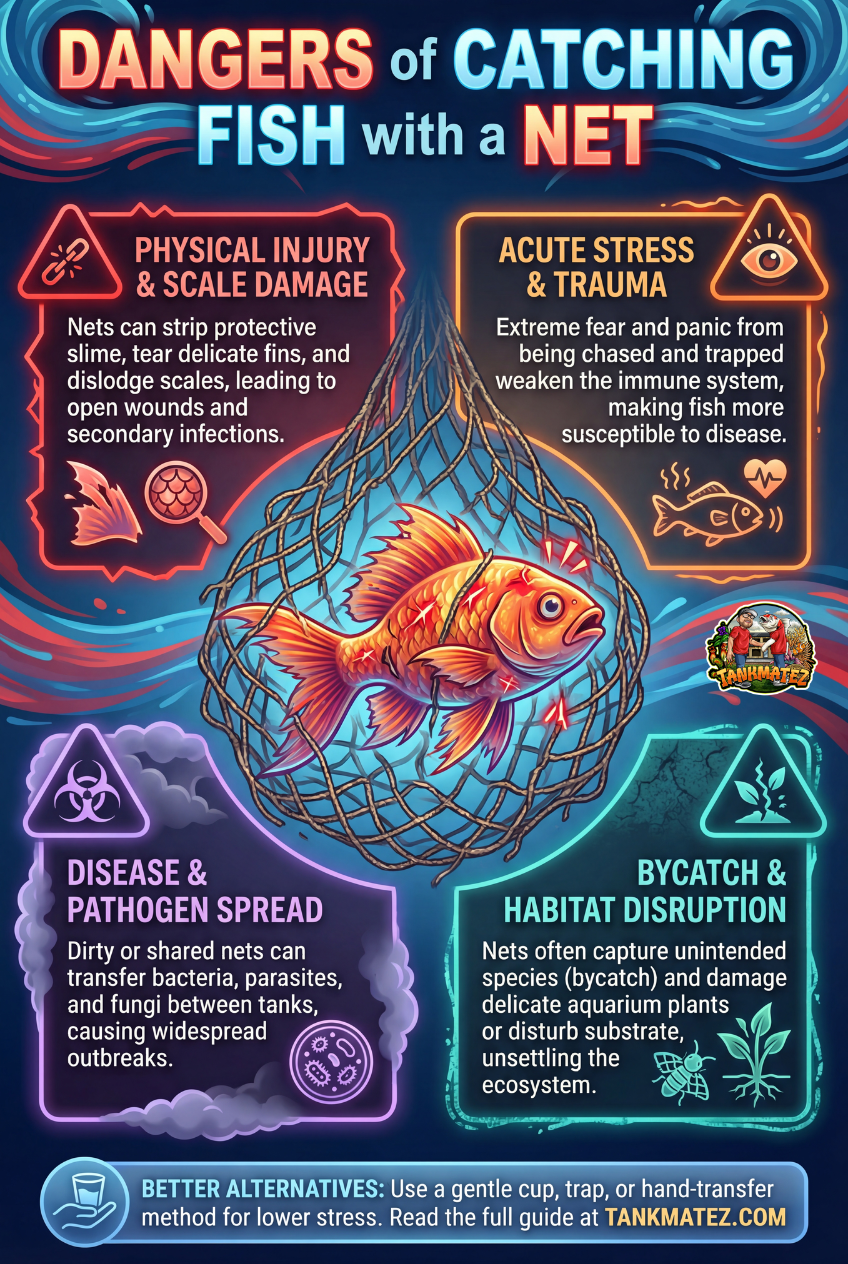
It can be. Nets often cause panic, fin tears, scale loss, and physical stress especially with repeated attempts.
What’s the safest way to catch expensive fish like wrasses, tangs, or gobies?
Use a gentle, transparent trap to protect their delicate scales and fast-moving nature. Wrasses and tangs especially respond well to bait-based traps.
Stop Hurting Your Fish With Nets. Try the Safer Solution
Make the switch to the TankMatez Bubble Fish Trap–the safe, humane, and zero-chase alternative to net fishing. Protect your fish and simplify your maintenance routine today.

TankMatez Magnetic Bubble Fish Trap
The TankMatez Magnetic Bubble Fish Trap is an innovative solution for every aquarium hobbyist’s age-old problem – the challenge of catching fish with a net. Instead of the usual frantic chase, which often ends up causing undue stress for the fish and potential harm to corals, this device provides a smooth, anxiety-free method to ensnare your aquatic friends. Click Here to see the setup video.