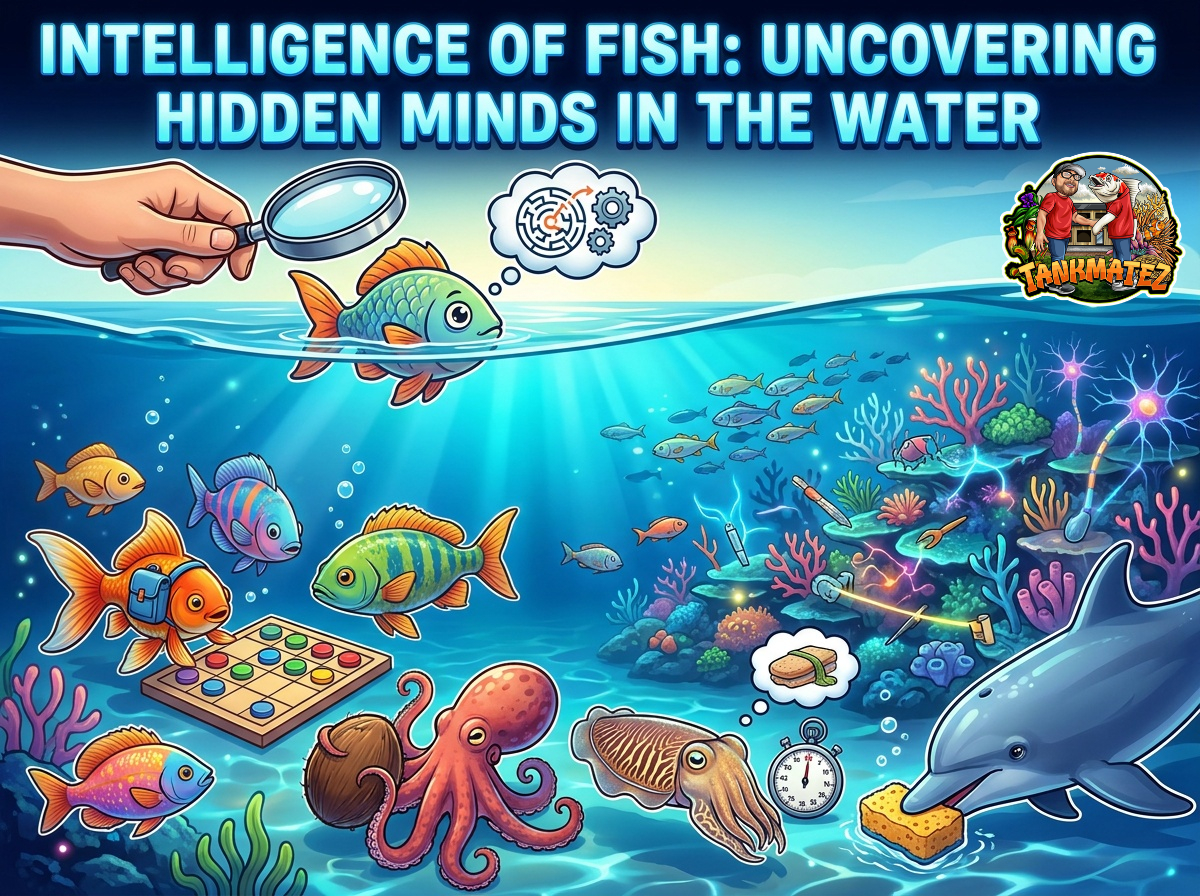
Intelligence of Fish: Uncovering Hidden Minds in the Water
Key Takeaways
- Fish are far smarter than myths suggest — the “3-second memory” idea is completely false.
- The intelligence of fish includes memory, learning, and problem-solving in both lab and wild environments.
- Fish can use tools, recognize individuals, and even develop social strategies.
- New research shows fish may be even more intelligent in natural habitats than previously believed.
- The intelligence of octopus, squid, and dolphins reinforces how advanced aquatic minds truly are.
- Fish are sentient and can feel pain, challenging outdated beliefs used to justify poor treatment.
- Public perception has been influenced by misconceptions, benefiting industries that rely on fish being seen as “less intelligent.”
- Understanding fish intelligence helps improve aquarium care, conservation, and ethical fishing practices.
Introduction
When most people imagine a fish, they think of a darting body with empty eyes, a creature driven purely by instinct.
The intelligence of fish has long been dismissed by popular culture and even by some scientists.
Myths such as the goldfish’s “three‑second memory” still circulate despite evidence to the contrary.
Why do we persist in believing that aquatic animals are simple? And what does recent research reveal about their cognitive lives?
At TankMatez.com, we believe that understanding the minds of fish and other marine animals fosters better care and empathy.
In this article we explore evidence that fish remember, learn, plan and even use tools. We will also look at the intelligence of octopus, squid and dolphins—other aquatic minds that challenge our assumptions and consider how misconceptions benefit industries that profit from catching fish.
The Intelligence of Fish: Myths, Facts, and Surprising Truths ▼
Debunking the Myth: Fish Have Long Memories and Complex Lives
Much of the public still assumes that fish forget almost instantly and float passively through life. This misconception is debunked by decades of research.
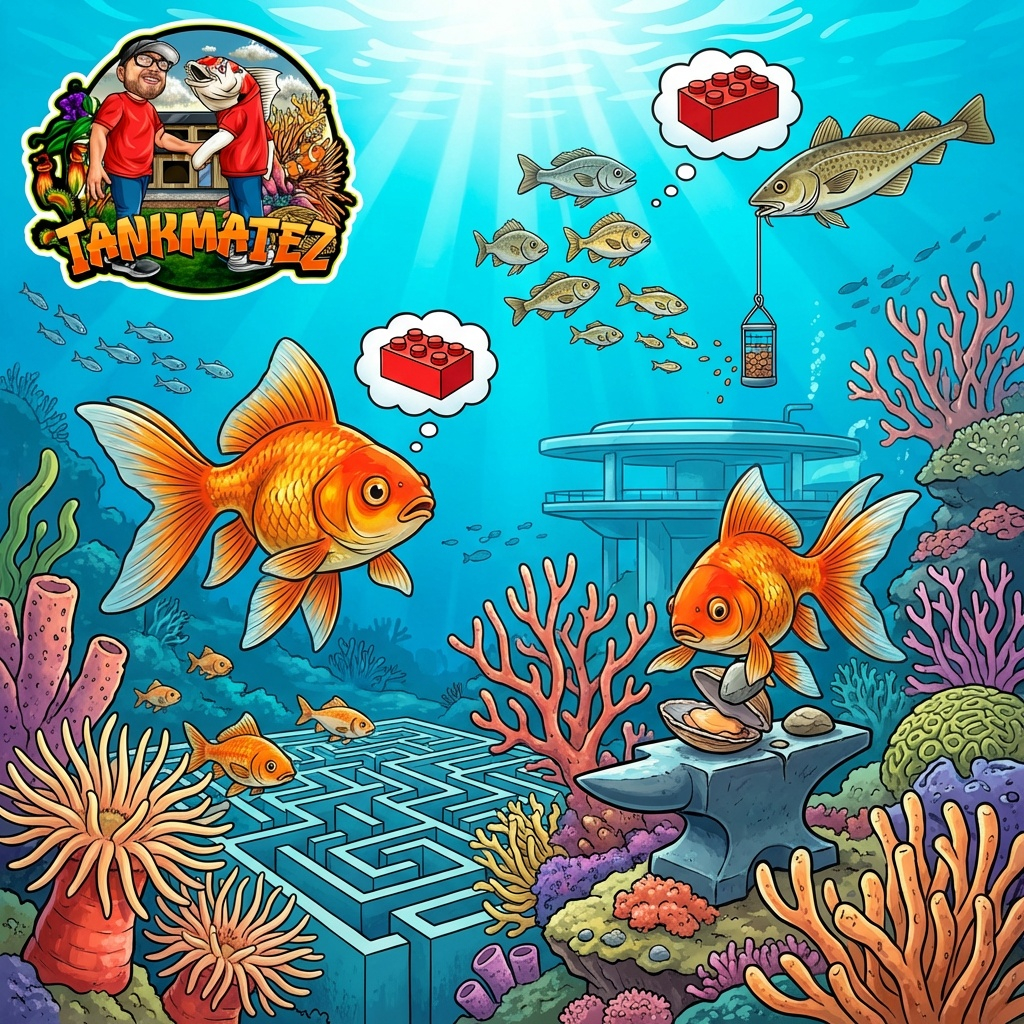
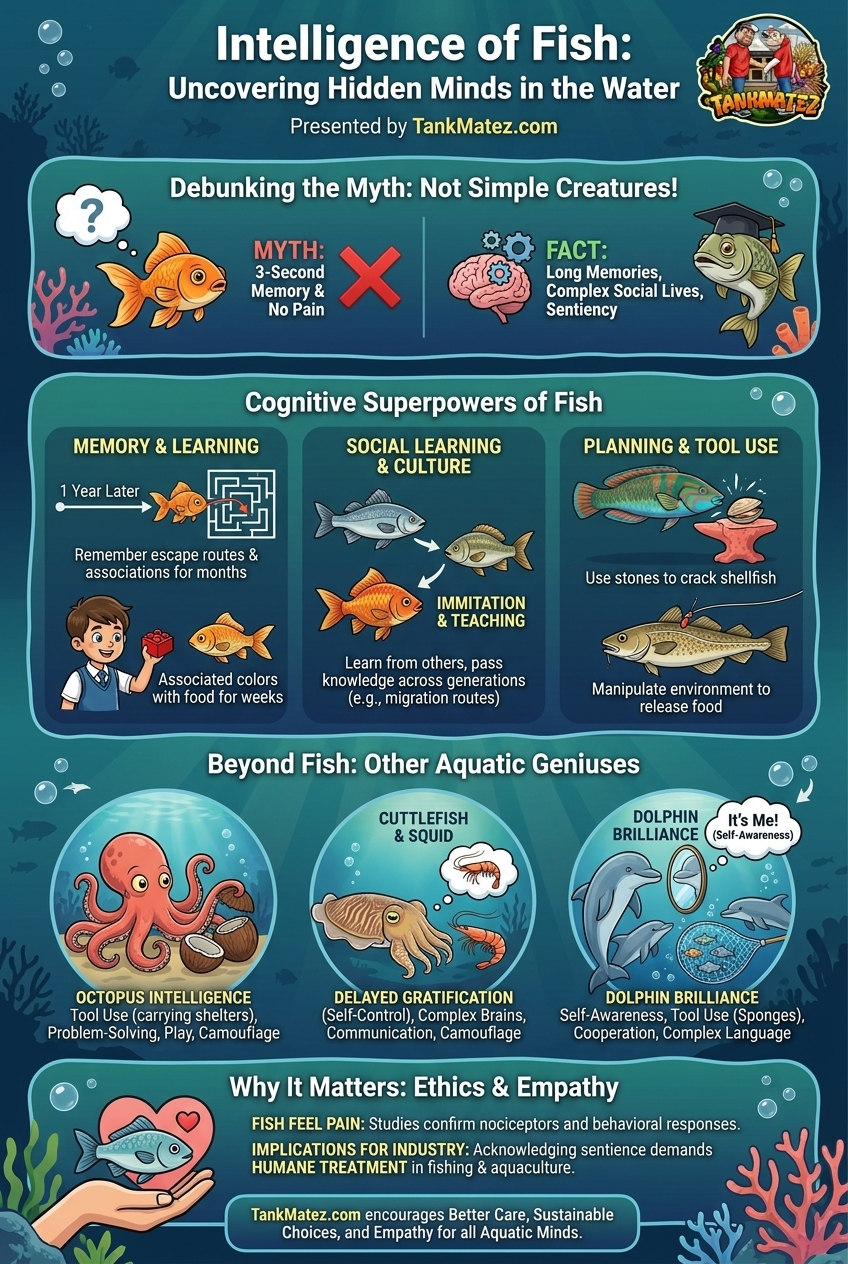
Biologist Culum Brown and colleagues taught fish to escape from nets and found that when tested a year later, the fish still remembered the route.
In a separate experiment, a schoolboy trained goldfish to associate a red Lego block with food; the fish remembered the association three weeks later and recalled it again after a week in the wild.
These demonstrations show that fish can form long‑term memories.
Fish also show social learning and culture. Brown explains that migrating fish learn routes from older individuals and pass this knowledge across generations.
Laboratory experiments show that fish can watch a trained individual perform a task and then replicate it themselves, indicating imitation and teaching. Such cultural transmission implies cognition beyond simple reflexes.
In addition to memory and learning, fish exhibit planning and tool use.
Researchers have observed species using stones to crack open shellfish, cod pulling a string with their dorsal tag to release a feeder and wrasses using coral as an anvil.
The Vancouver Humane Society notes that fish can plan, socialize and even play; they are sentient animals with the capacity to experience fear and enjoyment.
Scientific reviews summarized by IFLScience highlight that fish possess cerebral lateralization, allowing them to multitask, and they navigate using mental maps.
Clearly, fish cognition is rich and multifaceted.
Why Do People Underestimate Fish Intelligence?
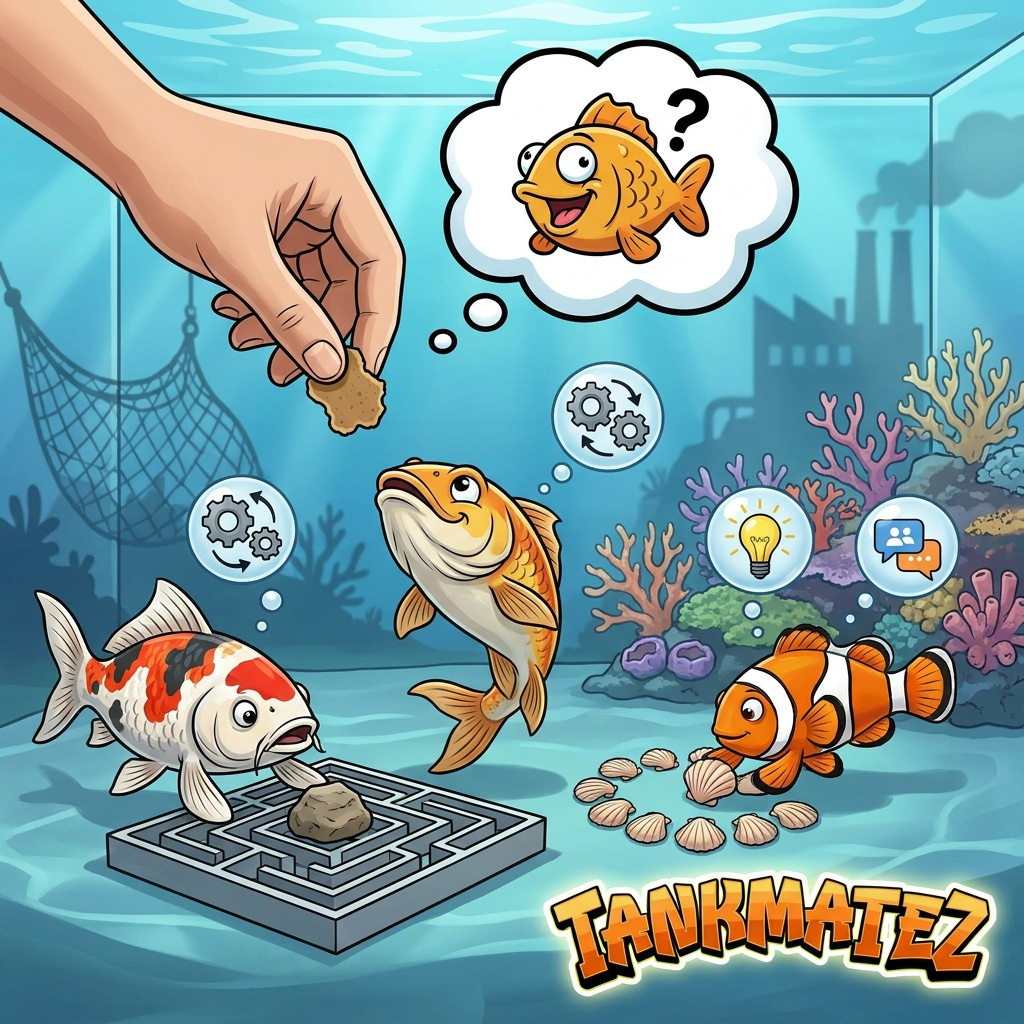
Despite this evidence, the stereotype of the “dumb fish” persists.
Part of the problem is that humans rarely interact with fish and cannot easily read their expressions.
As Culum Brown notes, we are biased because fish live in water and have faces very different from ours.
The Vancouver Humane Society points out that long‑held myths such as the three‑second memory—spread widely and discourage empathy.
Even well‑meaning aquarists may assume their fish do not notice when routines change or tanks are rearranged.
Another factor is industry interest.
Billions of fish are caught annually, and their welfare is often excluded from discussions about humane treatment.
Advocacy group FarmForward observes that fish are widely seen as less worthy of moral consideration, partly because they lack facial expressions and live out of sight. Sentient Media echoes this, noting that evidence of fish pain means industrial fishing inflicts mass suffering; scientist Lynn Sneddon argues that if fish are sentient we should treat them as we do mammals and birds.
Downplaying fish cognition benefits an industry built on consumption, and this may inadvertently perpetuate myths that fish do not feel or think.
New Research: Studying Fish Cognition in the Wild
Most laboratory studies of fish cognition use captive fish in tanks. While such experiments are controlled, they may underestimate what fish can do in natural habitats.
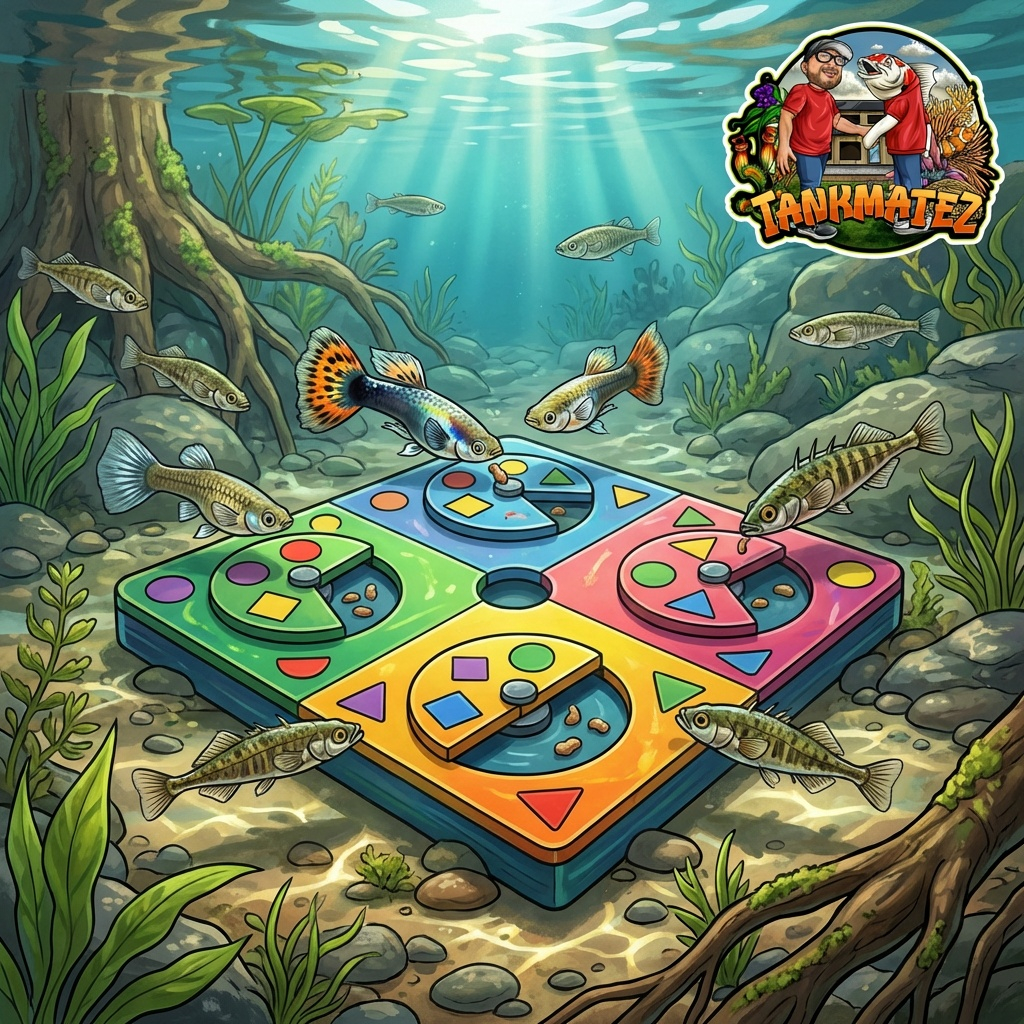
A 2025 article in Psychology Today summarizes new work by ecologist Catarina Vila‑Pouca and colleagues, who developed a low‑cost foraging board that can be placed in rivers and ponds.
The board contains pivoting discs covering food rewards; by marking the discs with colors or shapes, researchers can test discrimination learning, memory and even numerical ability. This apparatus allows fish to learn and make choices in the wild, revealing that they distinguish individuals, build mental maps, cooperate and use tools.
Field trials with Trinidadian guppies and nine‑spined sticklebacks revealed interesting behaviors.
Some guppies, dubbed “producers,” actively manipulated the board to obtain food, while “scroungers” waited to steal the reward.
In the Netherlands, most sticklebacks engaged with the board independently and varied in how quickly they learned.
The apparatus is adaptable across habitats and species, opening doors to study social learning, decision‑making and memory in wild fish.
Vila‑Pouca hopes such research will change public perception of fish and encourage more compassionate treatment.
Researchers at Wageningen University & Research have similarly highlighted the need to study fish in natural environments.
Their feeding‑board method shows that fish improve at selecting the correct disc over time, demonstrating learning and strategy.
The scientists note that the cognitive abilities of fish have long been underestimated because studies often take place in artificial settings.
Observing fish in the wild reveals explorers and opportunists—some individuals repeatedly experiment while others wait to benefit from their peers.
The team argues that this inexpensive, flexible device allows researchers to capture authentic behavior and has implications for conservation and welfare.
How Intelligent Are Octopuses?
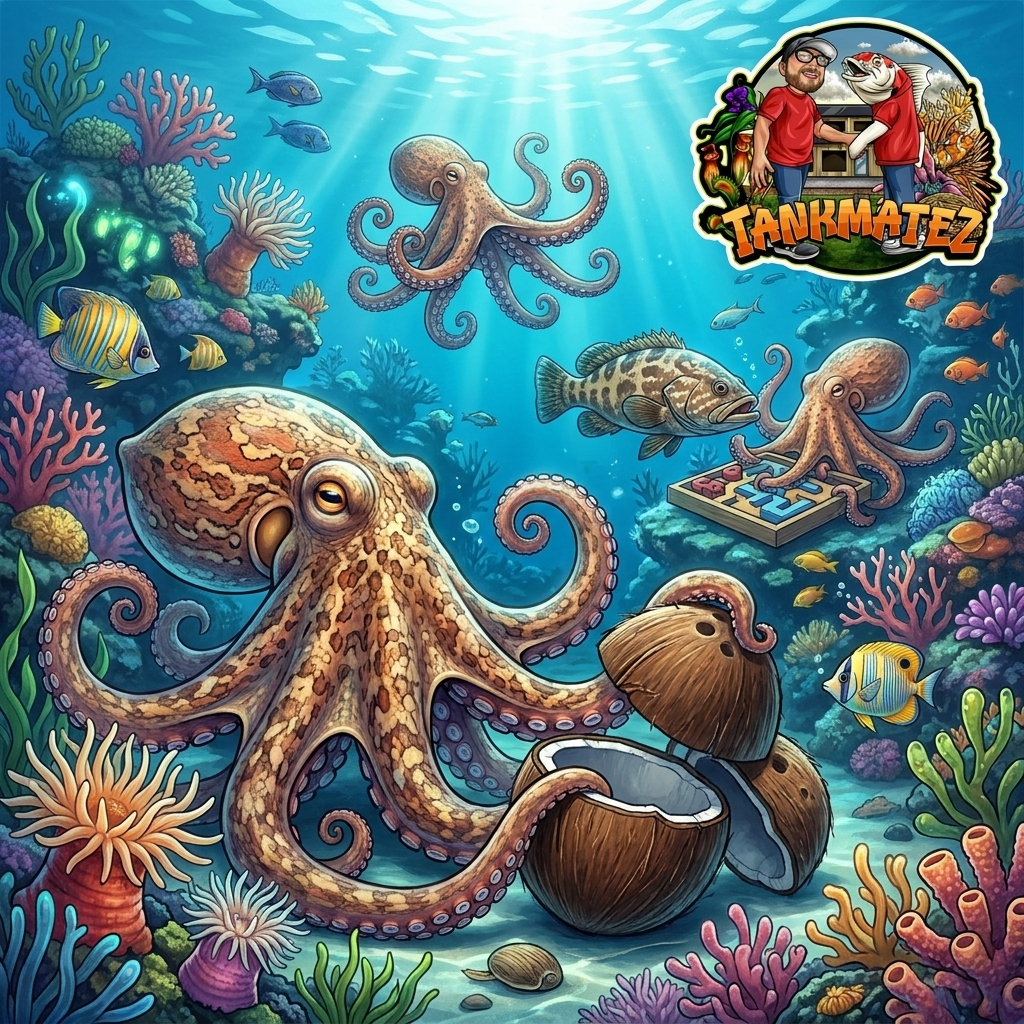
Octopuses captivate the imagination with their many arms, quick color changes and apparent problem‑solving skills.
Scientific evidence supports their reputation as some of the most intelligent invertebrates.
The Queensland Brain Institute reports that octopuses are masters of camouflage and can solve complex tasks; their cognitive abilities approach those of small mammals.
Brain structure varies among species, but reef‑dwelling octopuses have brains with a large cortical surface area reminiscent of primate brains.
Some species hunt collaboratively with fish and communicate visually during joint hunts.
Tool use provides another window into octopus intelligence.
In 2009, researchers observed veined octopuses collecting coconut shells and carrying them across the seafloor; they later assembled the shells to make protective shelters. This behavior qualifies as tool use because the animals gather and transport objects for future use rather than immediate consumption.
It suggests forethought and planning: the octopuses endure the awkwardness of carrying shells on stilted arms because they anticipate needing shelter later. Such actions challenge the notion that only primates and birds use tools.
Octopuses also demonstrate social learning and play. They explore objects through tactile investigation, learn tasks through reward and punishment, and can remember solutions for long periods.
Some octopuses at aquariums have been observed opening screw‑top jars or dismantling equipment; others engage in play by repeatedly squirting jets of water at objects.
These behaviors illustrate a sophisticated nervous system capable of curiosity, problem‑solving and experimentation.
Intelligence of Cuttlefish and Squid: Patience and Complex Brains
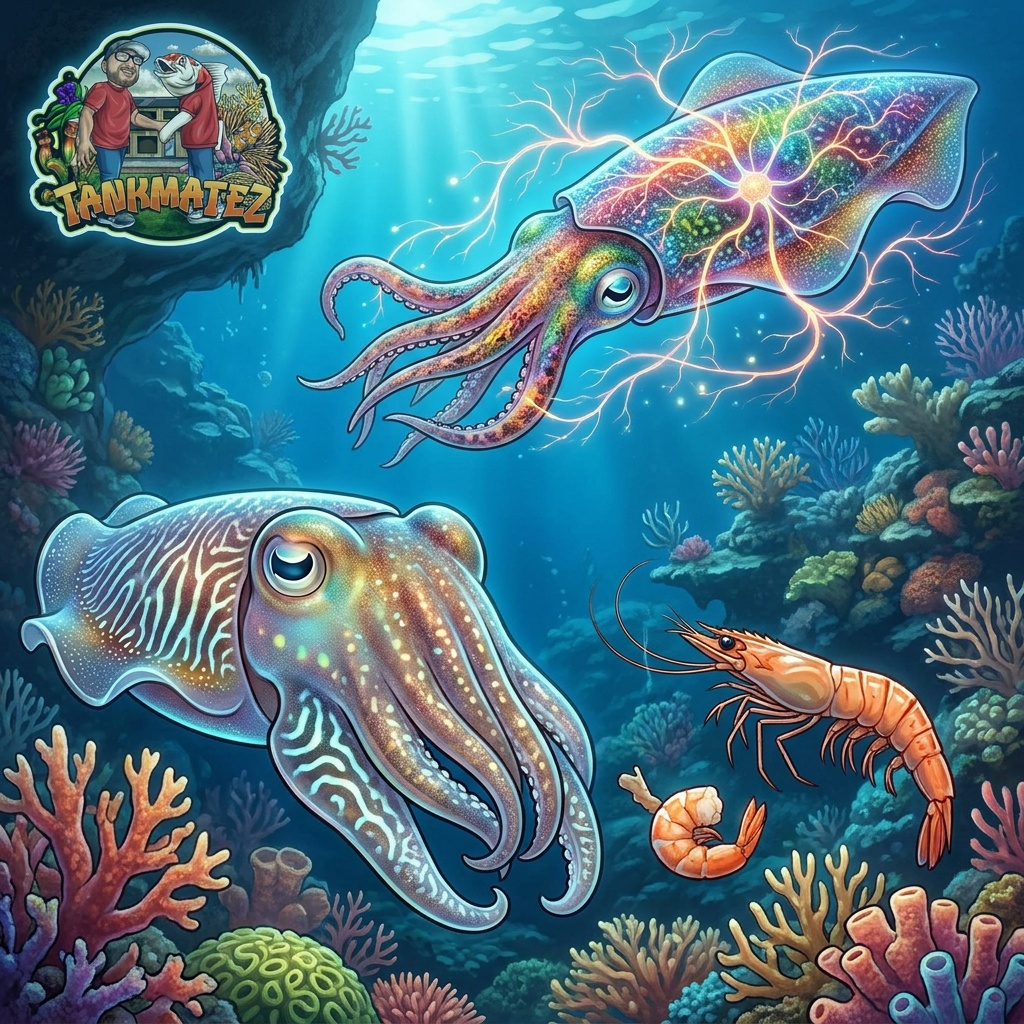
Cuttlefish and squid, fellow cephalopods, are equally impressive.
A 2021 study tested common cuttlefish using a version of the “marshmallow test,” a classic experiment of self‑control.
The cuttlefish chose between an immediate snack (a less‑preferred prawn) and a delayed but more desirable live shrimp.
The animals learned to wait for delays of up to 50–130 seconds to receive the better reward. This level of delayed gratification mirrors that seen in large‑brained vertebrates and suggests that cuttlefish can anticipate future outcomes.
The study also found that individuals who learned to ignore visual cues more quickly were the ones who waited the longest for the superior reward, indicating a link between cognitive flexibility and self‑control.
Squid brains are equally complex. An imaging study mapped the neural connections of squid and discovered previously unknown pathways.
Researchers aim to dispel myths of “alien intelligence” by showing that squid possess intricate nervous systems adapted to their ecological niches.
These cephalopods are masters of camouflage and can change skin color and texture almost instantly. Their intelligence evolved through divergent pathways from mammals, yet they exhibit problem‑solving, play and possibly communication.
Understanding squid cognition helps us appreciate the diversity of intelligence in the animal kingdom.
Dolphin Intelligence: Self‑Awareness, Tool Use and Cooperation
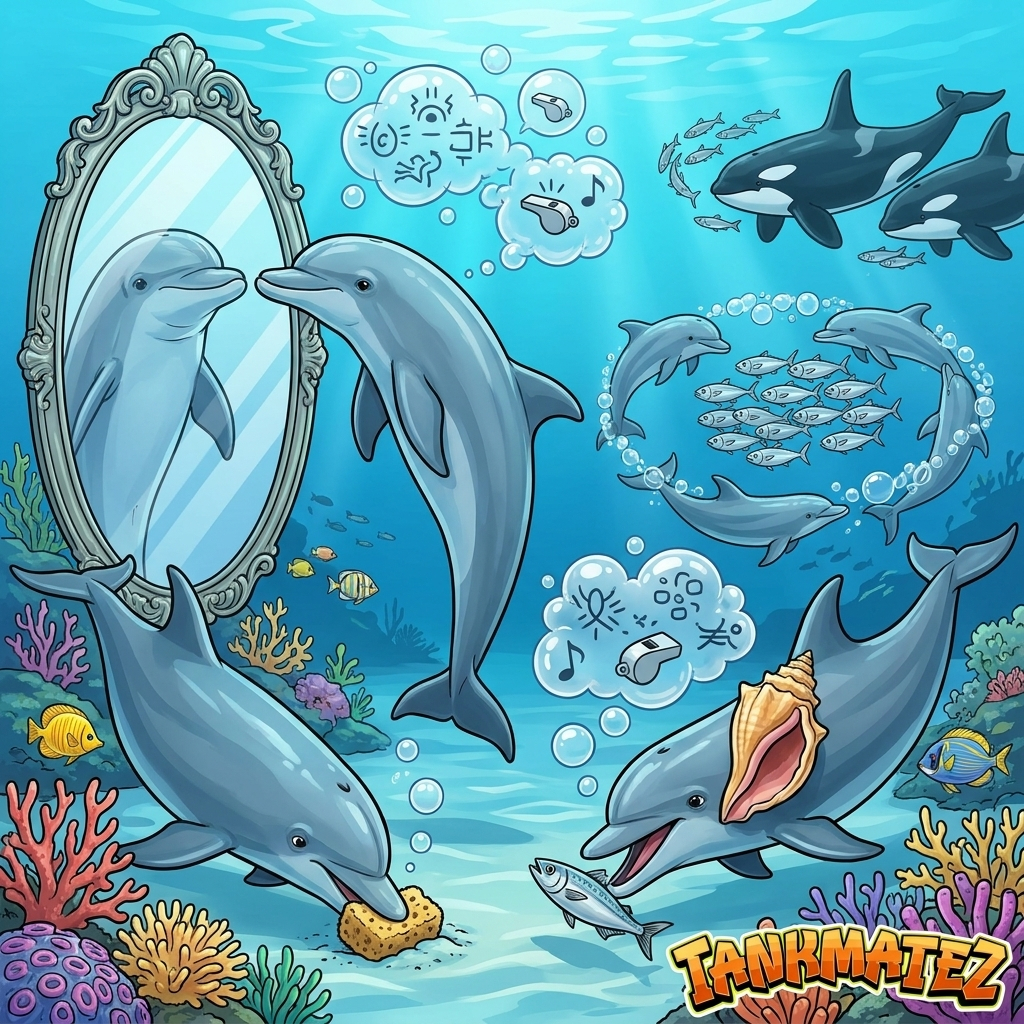
Among marine animals, dolphins are perhaps the best‑known for their intelligence.
The Wild Dolphin Project reports that dolphins demonstrate self‑awareness by passing the mirror test—a rare trait shared with humans, apes and some birds.
Bottlenose dolphin brains weigh around 1,600g and are four to five times larger than expected for their body size, giving them a high encephalization quotient. They possess specialized spindle neurons associated with abstract reasoning and problem‑solving.
Dolphins use tools and teach these skills to their young.
In Shark Bay, Australia, some dolphins place marine sponges on their snouts to protect against abrasion while foraging; mothers pass this technique to daughters.
Others use conch shells to trap fish and shake them into their mouths.
Dolphins also display cooperative hunting strategies: orcas herd herring with bubbles and tail slaps, humpback whales form “bubble nets,” and bottlenose dolphins coordinate to encircle schools of fish.
Complex communication underpins these behaviors.
Dolphins use signature whistles functioning like names and can learn symbol‑based sentences in captivity. They also show empathy, grief, playfulness and joy.
Fish Feel Pain and Deserve Consideration
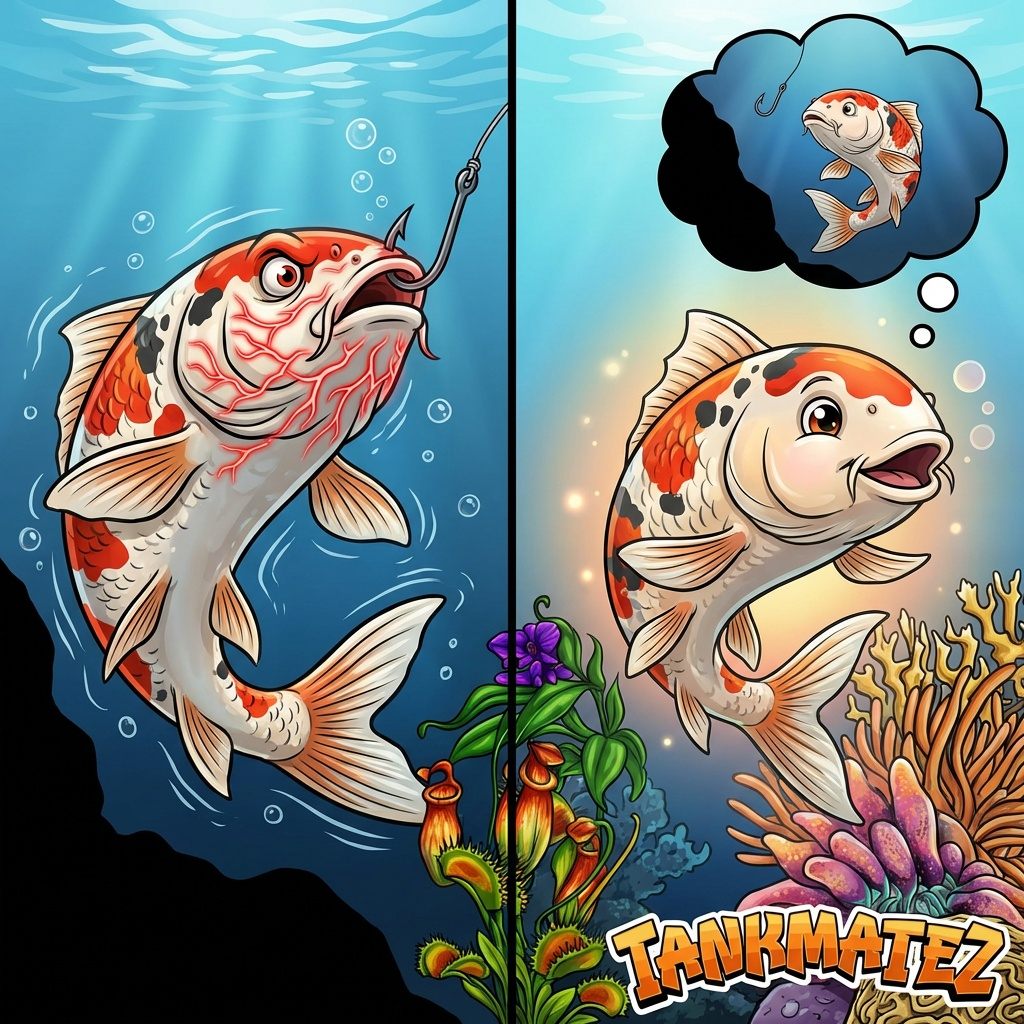
Intelligence is only one aspect of an animal’s inner life; the capacity to feel pain and suffering is another.
Scientific studies confirm that fish have nociceptors—pain receptors similar to those of mammals.
When hooked, fish show physical and behavioral responses consistent with pain.
Researchers observe that fish avoid areas where they previously experienced pain and respond to analgesics, indicating not just reflexes but a subjective experience.
The Vancouver Humane Society emphasizes that fish are sentient; they feel fear and enjoyment and show stress when handled improperly.
Recognizing pain in fish challenges practices such as catch‑and‑release angling and high‑intensity farming.
Implications for the Fishing Industry and Society
Understanding the intelligence of fish and other marine animals has ethical implications.
Industrial fishing kills billions of fish each year, often by suffocation or live gutting.
If fish can remember, learn and feel pain, then treating them as unthinking objects is morally untenable.
Advocacy groups note that industries benefit from portraying fish as simple; acknowledging their cognition would demand improvements in capture methods and welfare standards.
Unlike mammals and birds, fish receive little legal protection.
Broadening our conception of animal welfare to include fish could lead to humane slaughter methods, reduction of bycatch, and improved conditions in aquaculture.
Society’s perception of fish is beginning to shift.
Popular articles and documentaries are bringing fish intelligence to mainstream audiences, and new research tools allow scientists to demonstrate learning and personality in wild fish
As awareness grows, consumers may demand higher welfare standards, and policymakers may extend legal protections.
Recognizing fish as intelligent, sentient beings aligns with the ethical treatment we already afford to dolphins, whales and other charismatic marine animals.
Conclusion – Expanding Our Appreciation of Aquatic Minds
The myth of the mindless fish collapses under the weight of scientific evidence.
Fish remember escape routes for months, learn from others and use tools. Their cognitive abilities may be even greater in natural environments, as new field methods reveal.
Octopuses and cuttlefish display forethought, problem‑solving and self‑control, while dolphins show self‑awareness and complex social behaviors. These discoveries invite us to reconsider how we interact with aquatic life.
At TankMatez.com, we encourage fish keepers and seafood consumers alike to ask: If fish and cephalopods think, feel and suffer, how should that influence our choices?
Empathy for aquatic animals can inspire us to provide enriched environments for pet fish, support sustainable fisheries and demand humane treatment across the industry.
The intelligence of fish is not an abstract curiosity—it is a call to see our watery co‑inhabitants as subjects with their own experiences and to adjust our behavior accordingly.
By appreciating the remarkable minds beneath the surface, we can build a more compassionate relationship with the oceans.
Are fish intelligent?
Yes, fish are intelligent animals that demonstrate memory, problem-solving, social learning, and even tool use, making the intelligence of fish far more advanced than commonly believed.
What are signs of intelligence in common aquarium fish?
Signs include recognizing their owner, learning feeding routines, exploring new objects, solving simple challenges, showing curiosity, and interacting with tank mates in complex ways.
Can fish learn tricks or respond to commands?
Yes, many fish can be trained to follow targets, swim through hoops, push objects, and respond to visual or feeding cues through consistent repetition and reward-based training.
How can I buy interactive fish toys that stimulate fish intelligence?
You can buy interactive fish toys online from aquarium retailers or specialty sites like tankmatez.com, where products like the Bubble Fish Trap not only help with safe fish capture but also double as enrichment tools that encourage exploration and problem-solving.
Best enrichment toys for stimulating fish cognition?
The best enrichment toys include floating hoops, feeding puzzles, mirrored objects (used carefully), moving targets, and devices like interactive traps or feeders that require fish to think and explore.
What are some books about advanced fish behavior and training?
Popular books include What a Fish Knows by Jonathan Balcombe, Fish Cognition and Behavior by Culum Brown, and The Inner Life of Animals by Peter Wohlleben, all of which explore advanced fish intelligence and behavior.
Reviews of interactive fish feeders that promote cognitive skills?
Interactive fish feeders that require fish to search, push, or solve simple tasks are highly rated for promoting cognitive skills, and products like the tankmatez.com Bubble Fish Trap stand out because they encourage natural curiosity while serving a practical purpose.
How many brains does an octopus have?
An octopus has one central brain and eight additional neural clusters in its arms, allowing each arm to function semi-independently.
How intelligent are octopus?
Octopuses are extremely intelligent, capable of problem-solving, escaping enclosures, using tools, and showing curiosity and learning behaviors comparable to some mammals.
Why are dolphins so intelligent?
Dolphins are highly intelligent due to their large, complex brains, advanced social structures, communication systems, and ability to learn, cooperate, and use tools.
How intelligent are dolphins compared to humans?
Dolphins are among the most intelligent animals on Earth, showing self-awareness and complex cognition, but human intelligence is still more advanced in abstract reasoning, language, and technology.

Stop Stressing Your Fish! Upgrade to a Smarter, Safer Way to Catch Them
If fish are intelligent, they deserve better handling. The Bubble Fish Trap from TankMatez is designed to work with your fish’s natural curiosity—not against it—making capture safer, calmer, and far less stressful for your aquatic pets. Give your fish a smarter experience while making your life easier.

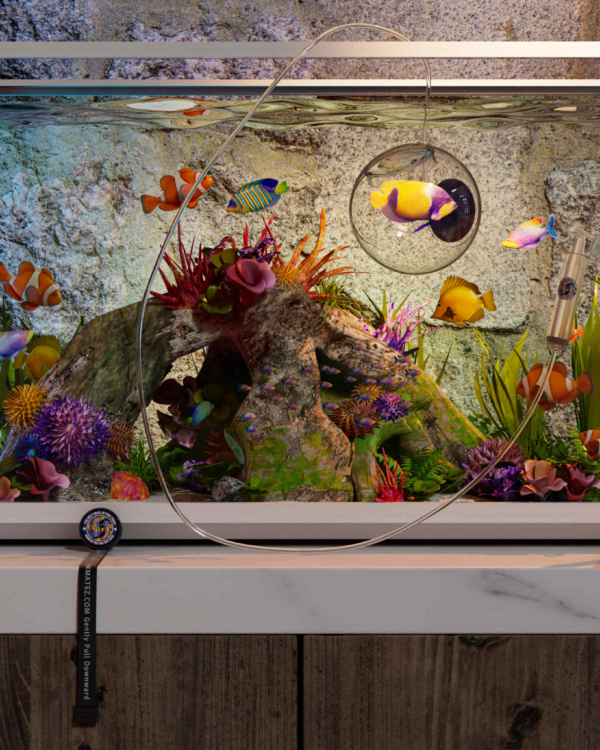
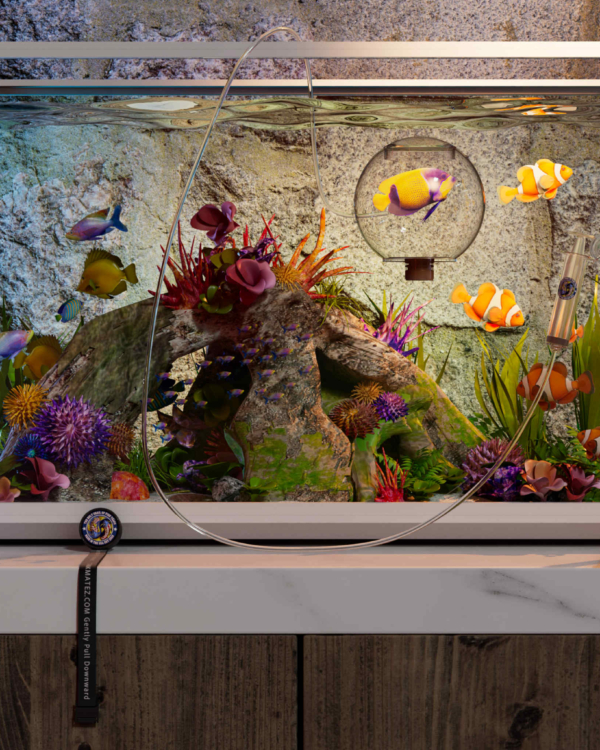


TankMatez Magnetic Bubble Fish Trap
The TankMatez Magnetic Bubble Fish Trap is an innovative solution for every aquarium hobbyist’s age-old problem – the challenge of catching fish with a net. Instead of the usual frantic chase, which often ends up causing undue stress for the fish and potential harm to corals, this device provides a smooth, anxiety-free method to ensnare your aquatic friends. Click Here to see the setup video.